

Introduction to six major process flows for stainless steel sheet metal processing:
What are the main steps involved in the common stainless steel sheet metal processing? Let me introduce them to you below:
Design of stainless steel sheet metal processing drawings ->laser processing or (CNC stamping) ->bending ->welding forming ->electrostatic powder coating or (liquid paint) ->packaging and shipping
Design of stainless steel sheet metal processing drawings: Generally, customers provide drawings or samples, which are measured, designed, unfolded by our company's engineering personnel, and finally formed into processing decomposition drawings and assembly drawings to be submitted to the production department for processing.
Stainless steel sheet metal processing laser processing: Our company has a large laser cutting machine (refer to the equipment introduction for details), which can cut and cut materials such as carbon steel and stainless steel. Using laser cutting for cutting, the cross-section of the workpiece is neat, smooth and beautiful after processing. Stainless steel sheet metal processing has precise dimensions and is more advantageous for workpieces with curved lines. It is an irreplaceable processing method for general CNC stamping.
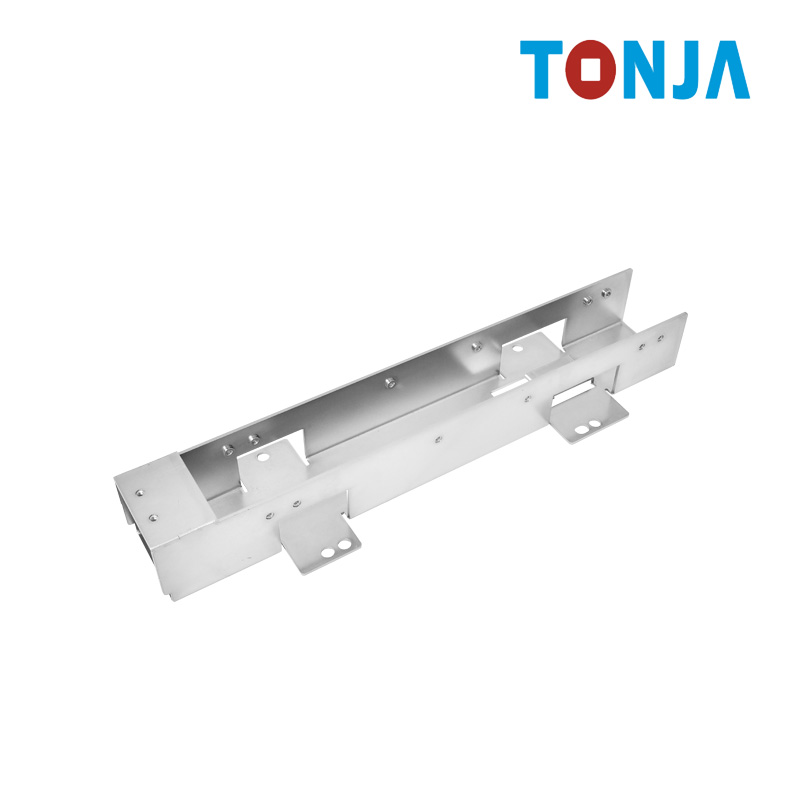
Stainless steel sheet metal processing CNC stamping: Our company has imported turret CNC punching machines from Finland. CNC stamping is mainly suitable for products with thin material thickness, generally below 2.5mm, and workpieces with many holes or requiring special molds (such as convex and concave molds) to be processed. When processing large batches, CNC stamping has certain cost advantages.
Bending: After the workpiece is cut, if most of it needs to be bent into shape, the company has multiple computerized bending machines, which not only have fast speed but also more accurate workpiece processing, providing a good guarantee for subsequent welding and assembly.
Welding Forming: After the workpiece is cut, it generally needs to be assembled into shape. There are various assembly methods, some of which are directly formed by non welding processes such as screws and rivets. This forming method is simple, environmentally friendly, and easy to disassemble, but it has complex design, weak structure, and unattractive appearance. Therefore, this type of assembly method is generally not adopted for mechanical shells. It is more suitable for office products such as furniture. Welding forming is commonly used for mechanical shell sheet metal. Companies generally adopt argon arc welding, impact welding, carbon dioxide welding, etc. After welding, the workpiece is polished and polished to make it more solid and beautiful.
Do you know the six major process flows for stainless steel sheet metal processing?
Electrostatic powder coating for stainless steel sheet metal processing: Electrostatic powder coating is mainly used for carbon steel workpieces. Stainless steel is generally cleaned with alcohol after welding, and then no longer needs to be treated. However, iron parts are prone to rust, so surface treatment is required. In terms of process, oil and rust removal, surface cleaning, phosphating treatment, electrostatic powder coating, high-temperature baking and other processes are generally carried out first. After treatment, the surface of the workpiece is beautiful (color and pattern can be chosen by oneself), and it will not rust for several years, with low cost and other advantages.
Liquid paint for stainless steel sheet metal processing: This process is different from electrostatic powder coating. It is generally used for large workpieces and has the advantages of convenience and low cost when it cannot be transported. Liquid paint is generally divided into two steps, applying primer and topcoat after workpiece processing.